![]() RONALD REAGAN40th President of the United States
|
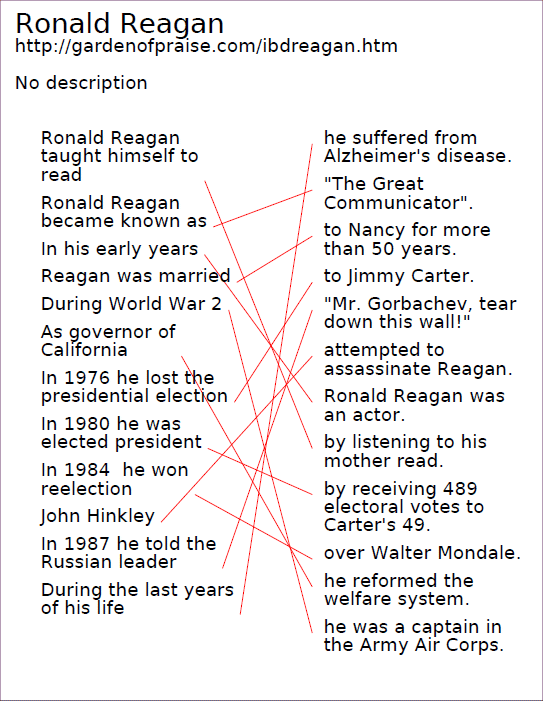
Ronald Reagan grew up in Illinois. His father was a shoe salesman. When he was very young, his mother read to him, moving her finger under the words as she read aloud. He taught himself to read by looking at the words as she read, and by the time he was five years old he could read the newspaper.
His mother was an amateur* actress performing onstage in local productions. She encouraged her boys to participate in the theater and public readings. These experiences served him well in later life as he became an actor and an excellent public speaker.
His mother taught him how to connect with people. She told him he needed to look them in the eyes, remember their names, and show them he cared about them. He followed her sage* advice and later became known as "The Great Communicator"*.
After finishing high school he graduated from Eureka College. Upon graduation he worked as a radio sportscaster, then hosted some TV shows. General Electric hired him to give talks to its employees. He visited all 139 GE plants and gave two or three speeches a day.
![]()
He became an actor and his acting career spanned several years. He was active in the Screen Actors Guild helping his fellow actors. He was married twice, both times to actresses. His first wife was Jane Wyman. They had a daughter and adopted a son. After their divorce he married Nancy Davis with whom he had a daughter and a son. They would be married for more than 50 years.
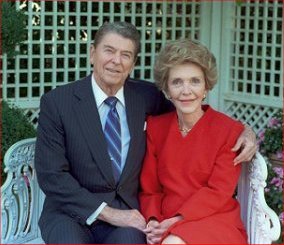
During World War 2 he served as a captain in the Army Air Corps making training films for pilots. After the war he switched political parties and became a Republican in 1962.
In 1967 he was elected governor of California. Reagan was a conservative* regarding his policies. He set out to reform the welfare* system which was out of control in California. In 1967 the California Welfare Act was signed and in 1971 he signed a welfare reform bill which required mothers and fathers without young children to work. The guidelines became stricter and the number of people on welfare was reduced. Within three years it had saved the California taxpayers 2 billion dollars.
In 1976 he tried to win the Republican nomination for President of the United States, but Gerald Ford was the nominee that year. Ford, however did not get elected and Jimmy Carter, the Democratic candidate became President.
Reagan was elected governor of California for a second term, then in 1980 he tried again for the Presidency and was elected winning over Jimmy Carter. Reagan had 489 electoral* votes to Carter's 49 votes.
When he became President one of his priorities was to increase the national defense and he advocated increased spending in that area. He pushed the Star Wars missile defense system. Under his leadership the economy stablized. During his first term as President he appointed Sandra Day O'Conner to serve on the Supreme Court. She was the first woman to ever serve in that capacity.
He proved to be so popular he won reelection in 1984 against the Democratic nominee, Walter Mondale. In that election he got 525 electoral votes to Mondale's 13. He advocated a smaller role of government in the lives of people. He bravely spoke out against abortion and for prayer in the schools .
There was an attempt on his life in 1981 when John Hinkley shot him in the chest. He nearly died, but fully recovered from the attack. His press secretary James Brady was struck in the head by one of the bullets and was not so fortunate. He suffered permanent brain damage due to the wound. After that incident stricter gun laws were enacted.
Reagan delegated authority whenever possible. He believed ,"If anyone else can perform a task as well as or better than you could, you should not do it."( From :"Reagan on Leadership" by James Strock)
He had a clear vision of the things he wanted to accomplish, and if a person was getting off-target, he would talk to that person and help him/her come to a better understanding of the goals.
For many years the United States and Russia had been engaged in what people termed a "Cold War".* There was no shooting or bombing, but there were ill-feelings and a distrust on both sides. Once in a meeting with Russian leader Mikhail Gorbachev, when they couldn't agree, Reagan walked out on him. Reagan stood his ground.
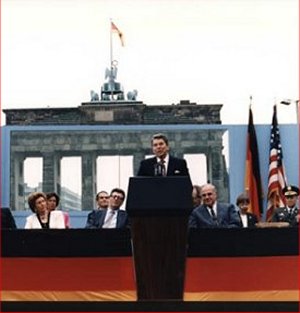
The Berlin Wall had been erected by the East German army after being advised to do so by the Russian leaders, thus dividing East and West Germany in 1961. Then on June 12, 1987 Ronald Reagan said to to the Russian leader, "Mr. Gorbachev, tear down this wall!" Within two years people were traveling freely between the two sectors. He had communicated. The wall came down. Prime Minister Margaret Thatcher said of Ronald Reagan, "He won the Cold War without firing a shot."
![]()
While he was President, Reagan kept a plaque on his desk which read, "There is no limit to what a man can do or where he can go if he doesn't mind who gets the credit."
When he made a mistake he owned up to it and tried to correct it if possible.
Once when asked about his legacy; how he wanted to be remembered, he said he wanted people to say, "He tried to expand the frontiers of human freedom in a world at peace with itself."
![]()
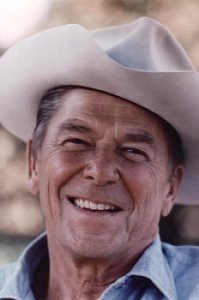
In his later years after he left the White House, Ronald Reagan developed Alzheimer's disease. In 1994 he wrote a letter explaining the sad situation and simply dropped out of public life. There were no more pictures or interviews with him after that time. He lived for ten more years, passing away in 2004.
![]()
Ronald Reagan Biography
Ronald Reagan Library
Ronald Reagan
at The Times 100
Google Videos
"President Reagan's Humor" and "Tear Down This Wall"
A Tribute to Ronald Reagan
reviews his best movies
"Tear Down This Wall"
Reagan's speech at the Brandenburg Gate in West Berlin, June 12, 1987
Ronald Wilson Reagan
at POTUS
Ronald Reagan Quotes
President Reagan, the Triumph of Imagination
read excerpts from this book by Richard Reeves
Ronald Reagan
CNN.com
American Experience
Ronald Reagan, PBS presentation
Ronald Reagan Biography
watch the video at American Experience
(double click on the picture to enlarge it)
Ronald Reagan
at Wikipedia.com
Ronald Reagan
another view at Spartacus
Presidents - coloring pages
Whitehouse Kids.gov
At biography.com search for Ronald Reagan.
Scroll the panel for the "Video & Audio Results".
(There is short ad before the video presentation.)
Ronald Reagan
By Carole Marsh / Gallopade International
Ronald Reagan came from humble beginnings. He loved football, acting, and America. From Hollywood to Washington, D.C., Reagan was loved by millions. He is considered one of the most popular presidents of the 20th century. These popular readers include easy-to-read information, fun facts and trivia, humor, activities and a whole lot more. They are great for ages 7-12 (grades 2-6), because although simple, these readers have substance and really engage kids with their stories. They are great for social studies, meeting state and national curriculum standards, individual and group reading programs, centers, library programs, and have many other terrific educational uses. 12 pages.
Ronald Reagan, A Man of Kindness: Pack of 25 Tracts
By Crossway Books & Bibles
A personalized encounter with Ronald Reagan describes his extraordinary kindess, the gospel defines his faith. Yielding our lives to Christ must be of our own choosing and a prayer of thanks, trust and help closes these tracts. Scripture from the ESV. Package of 25.
God and Ronald Reagan
By Paul Kengor / Harpercollins Publishing
From Sunday school to the Oval Office to the Berlin Wall, Ronald Reagan's strong political leadership was fed by ardent spiritual conviction. Inspired by Christian writers such as C.S. Lewis and Aleksandr Solzhenitsyn, he became convinced that religious freedom formed the bedrock of personal liberty. Explore how Reagan's faith shaped his worldview---and the world. 416 pages, hardcover from HarperCollins.
From Word Central's Student Dictionary
by Merriam - Webster
(Pronunciation note: the schwa sound is shown by &)
amateur
Pronunciation:AM-&-ty&r
Function: noun
a person who takes part in an activity (as a study or sport) for pleasure and not for pay
communicator
Pronunciation: k&-MYOO-n&-ka-tor
Function: noun
one who is able to transmit information, thought,
or feeling so that it is satisfactorily received or understood
conservative
Pronunciation: k&n-S&R-v&t-iv
Function: noun
a person who is cautious or moderate in his/her views
welfare
Pronunciation: WEL-fa&r
Function: noun
aid in the form of money or necessities for people in need
or a program through which such aid is distributed
sage
Pronunciation: sAj
Function:adjective
wise or prudent
electoral college
Function: noun
a body of electors; especially : one that elects the president and vice president of the U.S.
cold war
Function: noun
a struggle over political differences (as of two nations) carried on by methods short of war
and usually without breaking off diplomatic relations
Biographies in this Series
Presidents of the
United StatesGeorge Washington
1st U.S. President
John Adams
2nd U.S. President
Thomas Jefferson
3rd U.S.President
James Monroe
5th U.S. President
Andrew Jackson
7th U.S. President
Abraham Lincoln
16th U.S.President
Franklin D. Roosevelt
32nd U.S. President
John F. Kennedy
35th U.S. President
James Madison
4th U.S. President
Theodore Roosevelt
26th U.S. President
Ronald Reagan
40th U.S. President
Barack Obama
44th U.S. President-elect
American Patriots Benjamin Franklin
patriot and statesman
Francis Scott Key
Star Spangled Banner
Deborah Sampson
woman soldier in the Revolutionary War
World Leaders Constantine
Roman Emperor
Alexander the Great
conqueror
Winston Churchill
British Prime Minister
Inventors Alexander Graham Bell
telephone
Johann Gutenberg
printing press
Cyrus McCormick
mechanical reaper
The Wright Brothers
first airplane
Henry Ford
Automaker
Thomas A. Edison
electric light bulb
Sequoyah
Cherokee alphabet
Nikola Tesla
700 patents
. Explorers Christopher Columbus
explorer
Meriwether Lewis
explorer
Robert Peary
Arctic explorer
John Muir
Naturalist
Matthew Henson
Arctic Explorer
Sir Edmund Hillary
Mr.Everest
Kit Carson
Indian agent
"Johnny Appleseed"
orchardist
. Women who made
a differenceClara Barton
founder of the Red Cross
Helen Keller
overcame blindness & deafness
Florence Nightingale
founder of nursing profession
Joan of Arc
religious and military leader
Amelia Earhart
Aviator
Annie Oakley
sharpshooter
Susan B. Anthony
Suffragette
Elizabeth Keckly
Seamstress
Harriet Tubman
deliverer of slaves
Anne Frank
Diarist
Eleanor Roosevelt
Humanitarian
. Scientists George Washington Carver
botanist and educator
Sir Isaac Newton
explained gravity and properties of light
Marie Curie
scientist, physicist
Louis Pasteur
Biologist
Albert Einstein
physicist, genius
Galileo
Astronomer, physicist
Lise Meitner
Physicist
. . Educators Noah Webster
writer of dictionary
Booker T. Washington
leader and educator
Aristotle
Greek philosopher
Physicians Hippocrates
father of medicine
Walter Reed
discovered cause of yellow fever
Albert Schweitzer
humanitarian
Religious Leaders Increase Mather
Salem witch trials
. Athletes Lou Gehrig
baseball player
Wilma Rudolph
Olympic gold medal winner
Tiger Woods
golfer
Michael Phelps
Olympic swimmer
. . Civil Rights
LeadersMartin Luther King
civil rights leader
Rosa Parks
bus desegregation
Sojourner Truth
Former slave
Frederick Douglass
Abolitionist
Mary Ann Shadd Cary
Civil rights leader
James Forten
Inventor, abolitionist
Gandhi
Indian civil rights leader
César Chávez
Civil rights leader
. Composers Beethoven
composer
Artists John James Audubon
artist and naturalist
Gutzon Borglum
sculptor, Mount Rushmore
Ansel Adams
photographer
Home
Back to Famous Leaders
Pictures courtesy Wikimedia Commons
Puzzles on these pages courtesy of
Songs of Praise and Armored Penguin