Robert Peary
Arctic Explorer
Born in 1856 - 1920
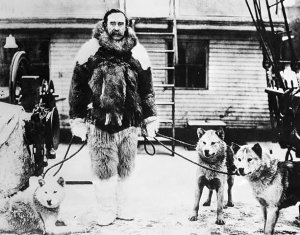
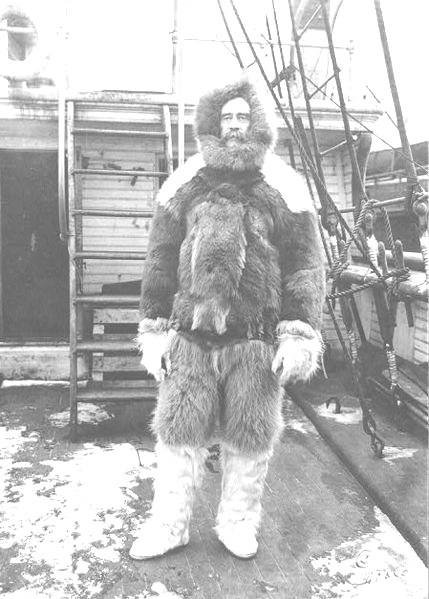
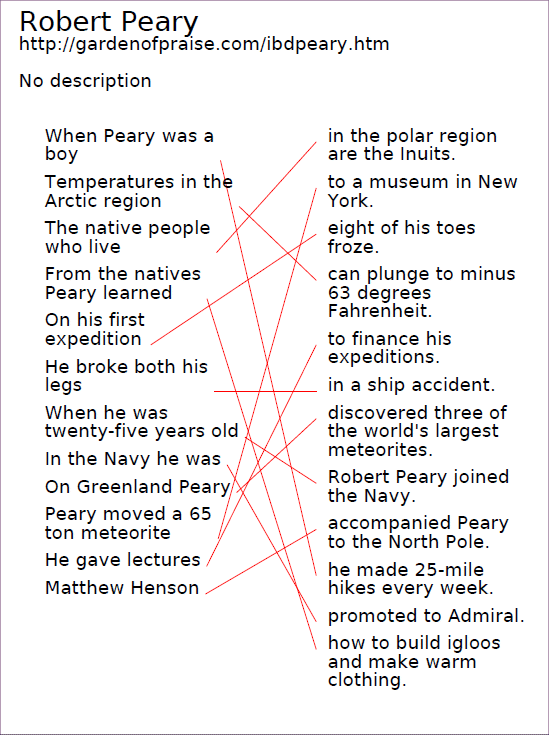
Robert Peary, even while he was still a boy, began preparing himself for the long expeditions he would make later in life. When he was young, he would make 25-mile hikes every week.
In 1898 he made his first attempt to reach the North Pole. He endured weeks of darkness and temperatures that plunged to minus 63 degrees Fahrenheit.
He had prepared himself well for polar exploration by studying the Inuit people who were native to the land. From them he learned how to build igloos, drive a dog sled, and make warm clothing out of animal skins.
On the first expedition eight of his toes froze and had to be removed. Later he would have the remaining two toes amputated because it was easier for him to walk with no toes than with only two toes.
On his second expedition both his legs were broken in a ship accident, but still he pushed on. He directed the construction of a base camp from his bed.
When he was 25 years old he joined the Navy, and after his eighth expedition he was promoted to the rank of Admiral. Sometimes he had trouble getting time off from his Naval duties to go on the expeditions.
On his third trip to Greenland he discovered three of the world's largest meteorites. One of them weighed 65 tons; 130,000 pounds. He was determined to bring it back and was finally successful in getting it to the American Museum of Natural History in New York.
He gave lectures to raise money, and by 1908 he had raised enough to finance his eighth expedition.
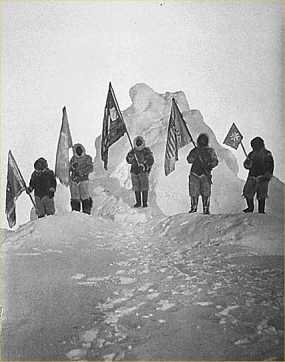
On the final part of the trip he was accompanied by five men; Matthew Henson, an African American, and four Inuits; Ootah, Egingwah, Seegloo, and Ooqueah. On April 7, 1909 he realized his dream of reaching the North Pole.
When he returned home, he learned that another man, Frederick Cook, claimed to have reached the pole a year earlier on April 21, 1908. Peary and his men tried to disprove Cook's claim. Some of Cook's documentation proved to be false. Also they learned he had been accused of fraud in an oil deal and served seven years in prison. He was eventually pardoned, but his reputation was ruined.
There was also controversy concerning Matthew Henson, who also claimed that while he was in Peary's party,
he was the first one to reach the Pole location.
Robert Peary died in 1920. He was 63 years old.
Peary had a son by an Inuit woman. This son later visited his father's family and his gravesite in Arlington National Cemetery in Washington, D.C.
This biography by Patsy Stevens, a retired teacher, was written in 2007.
Activities
Other Activities
Play an Online Game at Quia
Dictionary
From
Word Central's Student Dictionary
by Merriam - Webster
(Pronunciation note: the schwa sound is shown by ə)
expedition
Pronunciation: ek-spə-'dish-ən
Function: noun
a : a journey or trip undertaken for a specific purpose (as war or exploring)
b : a group making such a journey
Fahrenheit
Pronunciation: 'far-ən-'hIt
Function: adjective
Etymology: named for Gabriel Fahrenheit 1686-1736 German physicist
: relating or conforming to or having a thermometer scale
on which under standard atmospheric pressure
the boiling point of water is at 212 degrees above the zero of the scale
and the freezing point is at 32 degrees above zero
abbreviation F
amputate
Pronunciation: 'am-pyə-'tAt
Function: verb
to cut off; especially : to cut off an arm or leg from the body
Admiral
Pronunciation: 'ad-mə-rəl, -mrəl
Function: noun
a naval commissioned officer with a rank above that of captain;
especially : an officer with a rank just above that of vice admiral
meteorite
Pronunciation: 'mEt-E-ə-'rIt
Function: noun
a meteor that reaches the surface of the earth
documentation
Pronunciation: 'dahk-yə-mən-'tA-shən
Function: noun
the providing of documents as proof
Research Links
MinikPBS.org, a film about an Inuit boy brought by Peary to New York City.
The Peary-MacMillan Arctic Museum
Arlington National CemeteryPeary gravesite.
Robert Pearyfrom Wikipedia
Famous Americans Coloring Pages
Robert Edwin Peary, Arctic Explorerfrom Enchanted Learning, site for kids
"The North Pole"online book about his discovery by Robert Peary
"Famous Discoverers and Explorers of America"online book by Charles Johnston, Robert Peary
page 411
"Adventures of Uncle Sam's Sailors"online book by Robert Peary
The Snow Babythe story of Peary's daughter, Marie
You Wouldn't Want to be a Polar Explorerbased on Shackleton's Antarctic exploration
At biography.com search for Robert Peary.
Scroll the panel for the "Video & Audio Results".
Robert Peary, First to the Pole?has links to Arctic maps
Ralph Plaistedfirst expedition to
indisputably reach the North Pole
Ralph Plaistedat Wikipedia
Videos
Books
Press "Go" to search for books about Robert Peary
Library
A LIBRARY OF
ONLINE BOOKS and BOOK PREVIEWS
Order the following books from Amazon.
Polar Exploration Adventuresby Barbara Saffer (selected pages) Order
here
Exploring the Arcticby Rose Blue, Corinne J. Naden (selected pages) Order
here
The great white North: the story of polar exploration from the earliest times to the discovery of the poleby Helen Saunders Wright (public domain, published 1910, full view)
Robert Pearyby Kristin Petrie (selected pages)
Give Me My Father's Body: The Life of Minik, the New York Eskimoby Kenn Harper, Kevin Spacey (selected pages)
Into the ice: the story of Arctic explorationby Lynn Curlee (selected pages)
The Complete Idiots Guide to the Arctic and Antarcticby Jack Williams (selected pages)
Finding the North Poleby Frederick Albert Cook, Robert E. Peary, George W. Melville (selected pages)
Polar Regionsby James Kerr, Jim Kerr (selected pages)
Polar Regionsby Paul Mason (selected pages)
Credits and Solutions
Picture courtesy of
Wikimedia Commons.
Puzzles on these pages courtesy of
Songs of Praise and
Armored Penguin
* Word Match Solution
This page displayed 108,341 times.
This is a mobile page of
Garden of Praise. You are using a desktop computer. Try viewing the
mobile pages on your smart phone.







 A frequent question: