![]() LISE MEITNERPhysicist
|
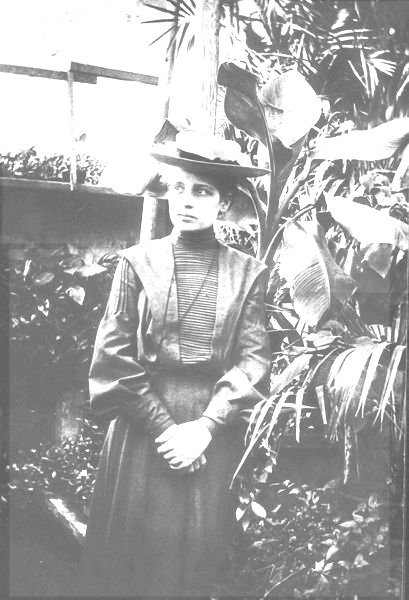
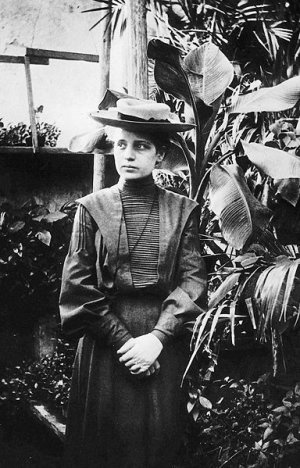
Lize Meitner (LEE zeh MITE nuhr) was born in Vienna, Austria November 7, 1878. She was the third child of eight children in the family. Her father Philipp, who was a lawyer, hired tutors to teach the children, and she received a good background in mathematics. Music was important to the family, and all the children learned to play the piano. One of her brothers even became a composer and concert pianist.
The Meitner children were taught to listen to their parents, but to think for themselves.
Her formal schooling as a child ended when she was fourteen years old, but she still wanted to learn. She asked her father if she could study at the University of Vienna. However, the classes there were closed to women and Jews. She, being a woman from a Jewish family, was excluded. Her parents insisted she first learn how to be a teacher before she pursued a higher education. They felt she needed to have some way to support herself financially.
Though Jewish, Meitner converted to Protestantism when she became an adult along with some of the other members of her family.
In 1899 the university began to admit women even if they lacked a high school diploma. She began to prepare for the entrance exam which was called the Matura. She finished an eight year study in two years. She took the exam and passed. Fourteen women took the test and only four passed. Meitner was one of them. She was able to enroll and attend physics* classes with the men. She was 23 years old. Five years later she had a PhD in Physics.
She went to the University of Berlin where she, as a woman, was not allowed to use the same lab as the men for her experiments.
![]()
While in Berlin she worked with Otto Hahn. She and Hahn discovered a radioactive* element and named it protactinium*. She did most of the work because Otto had to serve in World War 1. Hahn, however, received all the credit for the work. She asked him repeatedly to give her the recognition due her, but it never happened.
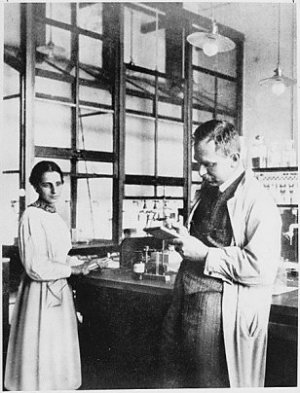
In 1944 Hahn would receive the Nobel Prize in Chemistry for the interpretation of nuclear* fission*. Meitner was not mentioned. Some say this was the greatest oversight ever made by the Nobel prize committee.She stayed in Berlin as long as she dared, but fled the Nazis because they were about to arrest her. After 30 years in Berlin she went to Sweden.
Sometimes she would write scientific articles and just sign them "L. Meitner". The publisher thought she was a man. When he learned "L. Meitner" was a woman, he quit publishing her articles.
She had named the process on which she was working nuclear fission. Without her knowledge other scientists built on her work and called it the "Manhattan Project" which was actually the development of the atomic bomb. She refused to help with the development of the weapon. Meitner did not know the end result of her discovery would lead to weapons of mass destruction. She wanted her discoveries to be used for peaceful purposes. To her dismay, her research resulted in the dropping of atomic bombs on Hiroshima and Nagasaki in Japan to bring about the end of World War 2.
![]()
Model, 1938 nuclear fission experiment
During her 60 years of work in the field of atomic physics she wrote 128 articles, served on scientific commissions, and served on the United Nations committee on atomic energy.
For many years she worked with her nephew, Otto Robert Frisch who was 34 years younger.
She and Eleanor Roosevelt in 1945 pledged to work together for world peace.
Albert Einstein affectionately called her "our German Madame Curie".
Two years before she died she received the Enrico Fermi* Award along with her co-workers Strassman and Hahn. In 1997, twenty-nine years after her death, the chemical element 109, the heaviest known element was named Meitnerium* in her honor.
On her gravestone is written "A physicist who never lost her humanity".Many of the facts in this story were found in the book Lisa Meitner and the Dawn of the Nuclear Age by Patricia Rife

![]()
Lise Meitner Online
Lise Meitner
information at UCLA
Lise Meitner,A Life in Physics
By Ruth Lewin Sime
Chemical Achievers
Lisa Meitner
Atomic Archive.com
Lize Meitner
short biography
Exploring the World of Physics: From Simple Machines to Nuclear Energy
By John Hudson Tiner / New Leaf Publishing Group
Do avoid learning or teaching physics at all costs? Exploring the World of Physics is designed specifically for those who think it's much too complicated for them! Each concept is clearly explained with text that speaks in laymans' terms, and illustrates each concept with examples from history and real life. Learn about the laws, principles and effects of physics throughout our universe that students from elementary to high school can understand. 158 indexed pages, softcover.
God's Design for the Physical World: Heat & Energy
By Answers In Genesis
Finding a biblically based science book isn't the easiest task in the world, but the God's Design series has certainly helped! Different forms of energy, nuclear, solar, chemical, mechanical, and thermal energy are covered, along with magnetism, light, sound waves and more. Designed for grades 3-8, graphs, photos, illustrations, biographical notes and fun facts take the tediousness out of textbook work; concepts are continually reinforced through chapter questions, experiments and unit quizzes. This is one book in a three part set which can be used in any order; each contains 35 lessons with one unit project to merge all the lessons together. A resource list, index, master list of all needed supplies, "challenge questions" for older students and full answer key are included. At the pace of 3 lessons a week, you can cover the series within a year. 150 partially reproducible pages, softcover.
From Word Central's Student Dictionary
by Merriam - Webster
(Pronunciation note: the schwa sound is shown by &)
physics
Pronunciation:FIZ iks
Function: noun
a science that deals with matter and energy and their actions upon each other
in the fields of mechanics, heat, light, electricity, sound, and the atomic nucleus
radioactivity
Pronunciation: RAID-e-o-ak-TIV-&h-te
Function: noun
the giving off of rays of energy or particles by the breaking apart of atoms of certain elements (as uranium)
protactinium
Pronunciation:proat-ak-TIN-e-&m
Function: noun
a shiny metallic radioactive element of short life
nuclear
Pronunciation: NYOO-kle-&r
Function:adjective
of, relating to, or using the atomic nucleus as nuclear reactions,
being or relating to energy or a weapon that involves a nuclear reaction
such as nuclear energy, a nuclear war, or nuclear power plants
fission
Pronunciation: FISH-&n
Function:noun
the splitting of an atomic nucleus resulting in the release of large amounts of energy
meitnerium
Pronunciation: mite-NIR-e &m
Function: noun
a short-lived radioactive element produced artificially
Fermi
Pronunciation:FEH(&)r-me
Function: proper name
Enrico 1901-1954 American (Italian-born) physicist; Nobel Prize winner (1938)
Biographies in this Series
Presidents of the
United StatesGeorge Washington
1st U.S. President
John Adams
2nd U.S. President
Thomas Jefferson
3rd U.S.President
James Monroe
5th U.S. President
Andrew Jackson
7th U.S. President
Abraham Lincoln
16th U.S.President
Franklin D. Roosevelt
32nd U.S. President
John F. Kennedy
35th U.S. President
James Madison
4th U.S. President
Theodore Roosevelt
26th U.S. President
Ronald Reagan
40th U.S. President
Barack Obama
44th U.S. President-elect
American Patriots Benjamin Franklin
patriot and statesman
Francis Scott Key
Star Spangled Banner
Deborah Sampson
woman soldier in the Revolutionary War
World Leaders Constantine
Roman Emperor
Alexander the Great
conqueror
Winston Churchill
British Prime Minister
Inventors Alexander Graham Bell
telephone
Johann Gutenberg
printing press
Cyrus McCormick
mechanical reaper
The Wright Brothers
first airplane
Henry Ford
Automaker
Thomas A. Edison
electric light bulb
Sequoyah
Cherokee alphabet
Nikola Tesla
700 patents
. Explorers Christopher Columbus
explorer
Meriwether Lewis
explorer
Robert Peary
Arctic explorer
John Muir
Naturalist
Matthew Henson
Arctic Explorer
Sir Edmund Hillary
Mr.Everest
Kit Carson
Indian agent
"Johnny Appleseed"
orchardist
. Women who made
a differenceClara Barton
founder of the Red Cross
Helen Keller
overcame blindness & deafness
Florence Nightingale
founder of nursing profession
Joan of Arc
religious and military leader
Amelia Earhart
Aviator
Annie Oakley
sharpshooter
Susan B. Anthony
Suffragette
Elizabeth Keckly
Seamstress
Harriet Tubman
deliverer of slaves
Anne Frank
Diarist
Eleanor Roosevelt
Humanitarian
. Scientists George Washington Carver
botanist and educator
Sir Isaac Newton
explained gravity and properties of light
Marie Curie
scientist, physicist
Louis Pasteur
Biologist
Albert Einstein
physicist, genius
Galileo
Astronomer, physicist
Lise Meitner
Physicist
. . Educators Noah Webster
writer of dictionary
Booker T. Washington
leader and educator
Aristotle
Greek philosopher
Physicians Hippocrates
father of medicine
Walter Reed
discovered cause of yellow fever
Albert Schweitzer
humanitarian
Religious Leaders Increase Mather
Salem witch trials
. Athletes Lou Gehrig
baseball player
Wilma Rudolph
Olympic gold medal winner
Tiger Woods
golfer
Michael Phelps
Olympic swimmer
. . Civil Rights
LeadersMartin Luther King
civil rights leader
Rosa Parks
bus desegregation
Sojourner Truth
Former slave
Frederick Douglass
Abolitionist
Mary Ann Shadd Cary
Civil rights leader
James Forten
Inventor, abolitionist
Gandhi
Indian civil rights leader
César Chávez
Civil rights leader
. Composers Beethoven
composer
Artists John James Audubon
artist and naturalist
Gutzon Borglum
sculptor, Mount Rushmore
Ansel Adams
photographer
Home
Back to Famous Leaders
Pictures courtesy Wikimedia Commons
Puzzles on these pages courtesy of
Songs of Praise and Armored Penguin