Albert Einstein
Physicist and Genius
Born in 1879, died in 1955
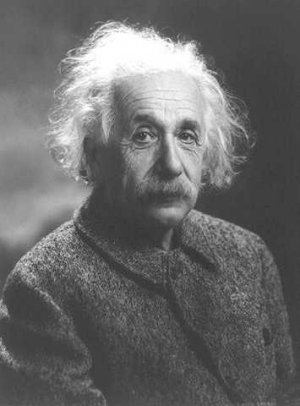
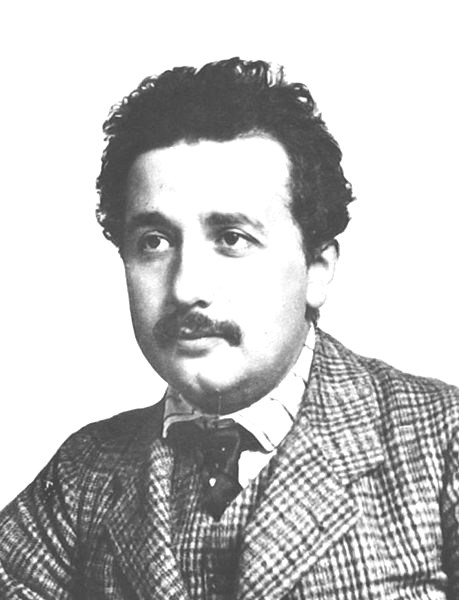
Albert Einstein (AL bert EYEn stine) was born in Ulm, Germany. His father was an electrical engineer, and his mother was a musician. She taught him to appreciate music, and he learned to play the violin.
When he was very young he was slow in development. He didn't speak until he was two years old, and even when he was older he had trouble answering a question. He would first silently mouth the words to himself and then slowly answer out loud. His teachers thought he would never be successful at anything.
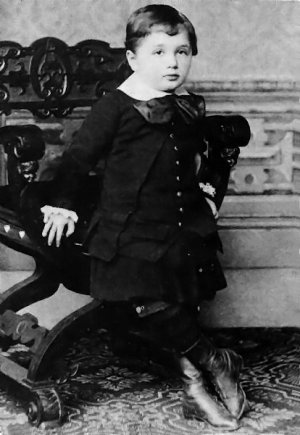
When he was six, his father gave him a compass. He was fascinated by the way the needle always pointed north. This experience helped to create a great curiosity in him and had an impact on the rest of his life.
His Uncle Jakob was a strong influence in his life. He gave Albert math books about algebraand geometry. Uncle Jakob described algebra as "a merry science". He said algebra could be compared to hunting a little animal. You didn't know the name of the animal, so you called it "x". Then when you finally caught the animal you gave it the correct name. He made learning fun for the boy and also provided a model for teaching that Albert would later use. In the future he would explain his theories by using examples of trains, elevators, and ships.
Once a week his parents invited a poor medical student, Max Talmey to eat with them. Max brought science books to share with Albert, and they became good friends.
His family moved to Munich, Germany where in elementary school he was the only Jew in a Catholic school. He attended a high school called Luitpold Gymnasium. He was bored at the school. His family next moved to Italy, but they wanted Albert to finish the school year in Munich. He wanted to leave Munich
so badly he got a false paper from a doctor stating he had a lung condition and must move to a dry climate (such as Italy where his parents were living). Then he convinced the school to give him a certificate in math so he could get into college. They complied because they wanted to get rid of him.
After a year in Italy he went to Zurich, Switzerland to study at the Polytechnic Institute. He failed the entrance examination and had to spend a year at another college before returning to Zurich.
Up to this point his life had been rather unremarkable. After college he took a job at the Swiss Patent Office examining patents for people's inventions. This job was ideal for him because he had a lot of free time for research about things that really interested him; things such as light and time.
The year 1905 was an exceptional year for Einstein. In that year he published three outstanding papers.
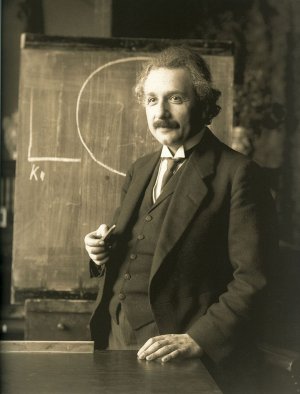
#1. He outlined his
photoelectric law in which he discussed the behavior of light. This led to the development of television and motion pictures with sound. In 1921 he was awarded the Nobel Prize for this paper.
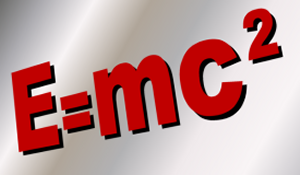
#2. The second paper, which was his most famous, explored the relation of mass to energy (E=mc squared) and addressed the problem of atomic energy. This paper provided the basis for the development of the atomic bomb. In 1939 he wrote to President Franklin D. Roosevelt and told him Germany was also working on nuclear fission which would lead to the development of a German bomb.
#3. The third paper was
On the Electrodynamics of Moving Bodies which is also known as the
Special Theory of Relativity.
Einstein spent hours experimenting with electromagnets. From his experiments he concluded the speed of light is always the same; 186,000 miles a second. This, he said, was as fast as anything could travel.
In 1933 when Einstein was visiting in the United States, the Germans stole his property and took away his German citizenship. The Institute for Advanced Study in Princeton, New Jersey invited him to be their director. He spent the rest of his life in America. After a few years he became a U.S. citizen.
Einstein was married two times; first to Mileva Maric with whom he had studied at the Polytechnic Academy. She was very smart and was a lot of help to Albert. They were married for sixteen years and had three children together, a daughter Lieserl and two sons, Eduard and Hans Albert. His second wife was Elsa, who was his first cousin. She had two daughters from a previous marriage. She and Albert had grown up together when they were children.
At the end of his life Einstein was a lonely man. His wife Elsa died after they had been married for seventeen years. His health began to fail and he died at the age of 76.
He spent his life working to find a balance between science and spirituality. He once said at a Symposium, "Science without religion is lame, religion without science is blind."
This biography by Patsy Stevens, a retired teacher, was written in 2006.
Activities
Other Activities
Play an Online Game at Quia
Dictionary
From
Word Central's Student Dictionary
by Merriam - Webster
(Pronunciation note: the schwa sound is shown by ə)
algebra
Pronunciation: 'al-jə-brə
Function: noun
a branch of mathematics that uses letters to represent numbers
and that studies numbers and the operations
(as multiplication and addition) that are used on them
geometry
Pronunciation: jE-'ahm-ə-'trE
Function: noun
a branch of mathematics that deals with points, lines, angles, surfaces, and solids
patent
Pronunciation: 'pat-ənt
Function: noun
1 : an official document granting a right or privilege;
especially : a writing granting to an inventor for a term of years
the only right to make, use, or sell his or her invention
2 : the right granted by a patent
photoelectric
Pronunciation: 'fOt-O-ih-'lek-trik
Function: adjective
involving, relating to, or using any of various electrical effects
due to the action of radiation (as light) on matter
fission
Pronunciation: 'fish-ən also 'fizh-
Function: noun
1 : a splitting or breaking up into parts
2 : the splitting of an atomic nucleus
resulting in the release of large amounts of energy
electromagnet
Pronunciation: i-'lek-trO-'mag-nət
Function: noun
a core of magnetic material (as soft iron) surrounded by a coil of wire
through which an electric current is passed to magnetize the core
symposium
Pronunciation: sim-'pO-zE-əm also -zh(E-)əm
Function: noun
1 : a group meeting at which there are several speeches
and often a group discussion
2 : a collection of opinions on a subject
Research Links
Albert Einsteinat Bio 4 Kids
Einstein's Big Ideafrom PBS
Albert Einstein - Image and ImpactAmerican Institute of Physics
Albert Einstein Archivesincludes a timeline of his life
Albert Einsteinbiography with audio version
Albert Einstein
English Lesson Plan on Albert Einstein
Famous Americans Coloring Pages
Color Me Physics - Coloring BookPhysics Central
Video "A is for Atom"14 minutes long
Physics AppletsMichael Fowler, University of Virginia
Einstein's WifeThe Life of Mileva Maric Einstein at PBS
Einstein (audio)
Einstein: Inventor (audio)
The Day I Met Einstein (audio)
Engines of Our Ingenuity.
"The Drama of Albert Einstein"online book by Antonia Vallentin
"Video about Albert Einstein"
At biography.com search for Albert Einstein.
Scroll the panel for the "Video & Audio Results".
Videos
Books
Press "Go" to search for books about Albert Einstein.
Library
A LIBRARY OF
ONLINE BOOKS and BOOK PREVIEWS
Order the following books from Amazon.
Albert Einstein, Ready to Read Level 3 by Patricia Lakin, Alan Daniel, Lea Daniel (selected pages) Order
here
Albert Einstein, Physicist and Genius by Lillian E. Forman (selected pages) Order
here
Albert Einstein and His Theory of Relativity by Don Herweck (selected pages) Order
here
Albert Einstein, A Biographyby Milton Meltzer (selected pages) Order
here
Albert Einstein by Anne Schraff (selected pages) Order
here
Albert Einstein: The Miracle Mind by Tabatha Yeatts (selected pages) Order
here
Albert Einstein by Carole Marsh (selected pages) Order
here
Albert Einstein, History Maker Bios by Stephanie Sammartino McPherson (selected pages) Order
here
Using Biographies in the Classroom by Garth Sundem, Shell Education,
See Sample pagesOrder
here
Great Scientists and Discoveriesby Ron Shaw (selected pages) Order
here
Odd Boy Out by Don Brown (selected pages) Order
here
Albert Einstein and the Theory of Relativityby Robert Cwiklik (selected pages) Order
here
Albert Einstein, First Biographies by Lola M. Schaefer, Wyatt S. Schaefer (selected pages)
Albert Einstein, Scientist and Genius by Suzanne Slade, Jolene Schultz (selected pages)
Albert Einsteinby Rebecca Gomez (selected pages)
Albert Einstein, Graphic Biography by Saddleback Educational Publishing, Inc. (selected pages)
Albert Einstein, Genius by Aaron Frisch (selected pages)
The complete idiot's guide to understanding Einsteinby Gary F. Moring (selected pages)
Fifty American heroes every kid should meetby Dennis Denenberg, Lorraine Roscoe (selected pages)
Albert Einstein: Physicist and Genius (Great Minds of Science)
(This book explains Albert Einstein's theories with illustrations
and simple language.)
Credits and Solutions
You may use the picture at the top of this page without permission. It came from the Library of Congress and is in the public domain.
Pictures of Einstein
Wikimedia Commons.
Puzzles on these pages courtesy of
Songs of Praise and
Armored Penguin
* Word Match Solution
This page displayed 326,114 times.
This is a mobile page of
Garden of Praise. You are using a desktop computer. Try viewing the
mobile pages on your smart phone.






 A frequent question: