BOOKER T. WASHINGTON


Born in 1856 - Died in 1915


Booker T. Washington
 

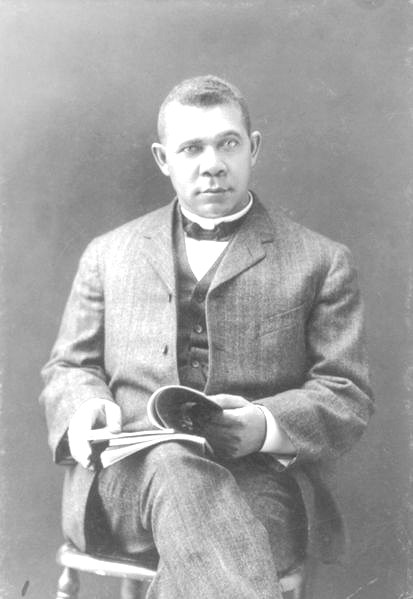
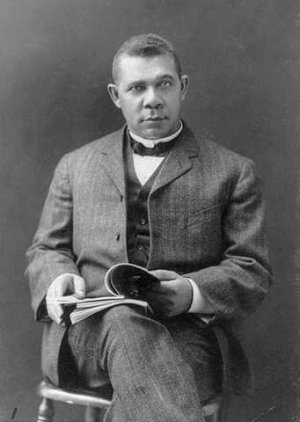
Booker T. Washington was born a slave in Franklin County, Virginia. His mother Jane was a cook for the plantation. He was biracial*, but he never knew his white father. He grew up in a small log cabin with a dirt floor. Each night a "pallet" was put on the floor for sleeping. Sometimes to feed her childen, Jane would take a chicken or eggs from the master's flock and cook them during the night.

His clothing was made of flax* which would prick the skin like needles until the shirt had been worn for about six weeks. Once his brother John offered to wear Booker's shirt until it was softer. His first pair of shoes had wooden soles and coarse leather tops.

One of his duties as a boy was carrying sacks of corn to the mill on the back of a horse. If a sack fell off, he might wait for hours for someone to come along and replace it on the horse's back.

One day the slaves were all called to the house of their owner, James Burroughs. A paper was read to them telling them they were now free. His step-father, who earlier had gone to West Virginia, sent a wagon to bring Booker and his family to their new home. The trip took about ten days.

After the move, his mother took a young orphan into the family. Now there were four children; James B., who was the new brother, Booker, John, and Amanda.

His step-father, who worked in the salt mines, got jobs for Booker and John in the salt mines. Sometimes they worked in the coal mines.

Mr. William Davis opened a school for colored children. Booker's parents permitted him to attend if he worked before and after school. He worked from 4:00 AM to 9:00 AM in the mines, then went to school half a day. After school he went back to the mines.

He said his first day at school was the happiest day of his life. When the teacher asked his name he said, "Booker". All the other children gave a first and last name, so Booker chose to take the name "Washington", his step-father's first name, as his second name. He later learned from his mother he did have a second name; Taliaferro.

He soon had to drop out of school to work full time in the coal mine. However, his mother found him another job as a houseboy for the family of General Lewis Ruffner. General Ruffner's wife was very strict with Booker. Once he ran away and started working as a waiter for a steamboat captain, but he didn't know how to be a waiter and failed at the job. He returned to Mrs. Ruffner and she took him back. She arranged for him to get some schooling.

He proved his trustworthiness* to her by selling fruit and vegetables to the miners and carefully accounting for all the money he received. He found being honest always had its reward. He stayed with Mrs. Ruffner four years and came to regard her as one of the best friends he ever had.

He heard about the Hampton Institute in Virginia, a school for black boys and girls. He determined to go to the school. He got as far as Richmond and spent a few days there sleeping under a plank sidewalk at night and loading a ship during the day to earn money to buy food.

He arrived at Hampton Institute and the lady principal told him to sweep a room for her. He knew it was a test. He swept and dusted the room three times until not a speck of dirt remained. He was accepted into the school. He would work as the assistant janitor to pay for his room and board at the school.

His mother Jane died while he was at home for vacation during the summer. It was a very sad time for him.

Miss Nathalie Lord, one of his teachers at Hampton, gave him lessons in elocution* or public speaking. These lessons would prove vital to his success later on.

After graduation he returned to his hometown, Malden, and became a teacher at the first school he ever attended. In the day school he had a class of 80-90 students. He also taught night classes and two Sunday schools. He encouraged several of his students to attend Hampton Institute. He also sent his brother John and adopted brother James to the school.

General Armstrong, the principal at Hampton, invited Booker to return to the school as a teacher and a post-graduate student. He taught a night class for students who had to work during the day. He also taught a class of 75 Indian boys.

Mr. George Campbell, a prominent white man in Tuskegee, Alabama, wanted to start a school for black children in that town. General Armstrong recommended Booker for the position. The state legislature would give $2000 a year for the school. He started having classes in an old church and a run-down building. When it rained, one of the taller students would hold an umbrella over the teacher's head to keep him dry.

He was able to purchase farmland eventually totaling over 2,000 acres on which to build the school.

He married Fannie Smith and they had a daughter, Portia. Within the year Fannie passed away and did not get to see Portia grow up nor see the school succeed.


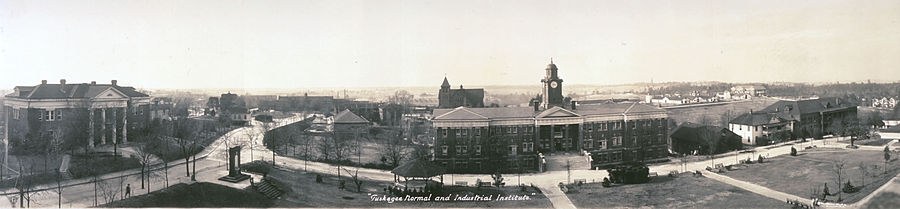
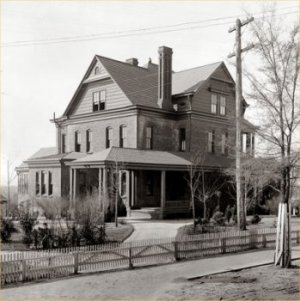
Tuskeegee Institute 1916

All students at the school were required to work in addition to their academic* studies. They chopped trees, cleared land, made bricks, built furniture, and constructed buildings. Classes were started to teach trades and professions.

Booker T. Washington was an eloquent speaker and used this skill for the benefit of Tuskegee Institute. The school continued to grow.

Booker married again. Olivia Davidson, assistant pricipal of the school, was his wife for four years and mother to two sons before she too passed away. Four years later he married Maggie Murray, a teacher at Tuskegee.
In 1895 he was invited to give a speech at an Exposition in Atlanta. In it he urged blacks and whites to work together. Afterward Harvard University gave him an honorary degree.

Friends gave money for Booker and his wife to visit Europe where they had tea with Queen Victoria.

The school flourished. George Washington Carver came to teach agricultural* science. People of wealth took an interest in the education of blacks. Andrew Carnegie helped.
Booker T. Washington, more than any other black man of his time, helped to elevate his people through education.

Facts for this story were taken from The Booker T. Washington Papers


Up From Slavery
Booker T. Washington autobiography online

Booker T. Washington Papers
University of Illinois Press

Booker T. Washington
from Wikipedia

Booker T. Washington
from U.S. History.net

Booker T. Washington
at Spartacus.schoolnet

Booker T. Washington, Legends of Tuskegee

The Booker T. Washington Era

Tuskegee Institute

Booker T. Washington, The Master Mind of a Child of Slavery
Online book by Frederick E. Drinker

Unsung Heroes
Online book by Elizabeth Ross Hayes, Booker T. Washington, page 63

W.E.B. DuBois Critiques Booker T. Washington
(You may want to increase text size for easier reading.)

My Own Books
personalize an online story about Booker T. Washington
by inserting your name in the story


102679: Up From Slavery, audiobook on CD Up From Slavery, audiobook on CD
By Booker T. Washington / Tantor Media Inc.

The history of the African in America has often been personalized or embodied within one individual, one spokes-person who represented the sentiments of the moment. In the South of the 1890s, Booker T. Washington stood as the often controversial personification of the aspirations of the black masses. The Civil War had ended, casting an uneducated black mass adrift or, equally tenuous, creating a class of sharecroppers still dependent on the whims of their former owners. Black Reconstruction, for all its outward trimming, had failed to deliver its promised economic and political empowerment. While an embittered and despairing black population sought solace and redemption, a white citizenry systematically institutionalized racism. From this Armageddon rose this Moses, Booker Taliaferro Washington, who was born in 1856 in Virginia, of a slave mother and a white father he never knew. But he gave no indication in his autobiography of the pain this almost certainly caused him: "I do not even know his name. I have heard reports to the effect that he was a white man who lived on one of the nearby plantations. But I do not find especial fault with him. He was simply another unfortunate victim of the institution which the nation unhappily had engrafted upon it at that time." After Emancipation, Washington began to dream of getting an education and resolved to go to the Hampton Normal Agricultural Institute in Virginia. When he arrived, he was allowed to work as the school's janitor in return for his board and part of his tuition. After graduating from Hampton, Washington was selected to head a new school for blacks at Tuskegee, Alabama, where he taught the virtues of "patience, thrift, good manners and high morals" as the keys to empowerment. An unabashed self-promoter (Tuskegee was dependent upon the largesse of its white benefactors) and advocate of accommodation, Washington's "pick yourself up by your bootstraps" and "be patient and prove yourself first" philosophy was simultaneously acclaimed by the masses, who prescribed to self-reliance, and condemned by the black intelligentsia, who demanded a greater and immediate inclusion in the social, political, and economic fabric of this emerging nation. Washington's philosophy struck a chord that played like a symphony within the racial politics of the times. It gave a glimmer of hope to the black masses; it created for whites a much-needed locus for their veneer of social concern-funds flooded into Tuskegee Institute; and finally, the initiatives of the black intelligentsia, led by W. E. B. Du Bois, were, for the moment, neutralized. Washington "believed that the story of his life was a typical American success story," and he redefined "success" to make it so: "I have learned that success is to be measured not so much by the position that one has reached in his life as by the obstacles which he has overcome while trying to succeed." His powerfully simple philosophy that self-help is the key to overcoming obstacles of racism and poverty has resonated among African Americans of all political stripes, from Marcus Garvey to Louis Farrakhan. Unabridged. 7 hours, 30 minutes. 8 CDs. Read by Norman Dietz.

414793: Booker T Washington Booker T Washington
By Carole Marsh / Gallopade International


Booker T. Washington Word Search


Booker T. Washington Crossword Puzzle


Booker T. Washington - Word Scramble

Online Crossword Puzzle

Online Word Search


Booker T. Washington Study Sheet


Worksheet


Work a Jigsaw Puzzle


From Word Central's Student Dictionary
by Merriam - Webster

(Pronunciation note: the schwa sound is shown by &)

biracial
Pronunciation: (')bI-'rA-sh&l
Function: adjective
having biological parents of two different ethnic identities

flax
Pronunciation: 'flaks
Function: noun
a slender plant with blue flowers that is grown for its fiber
from which linen is made and for its seed
from which oil and livestock feed are obtained;
also : its fiber

trustworthy
Pronunciation: 'tr&st-"w&r-[th]E
Function: adjective
deserving confidence : dependable

elocution
Pronunciation: "el-&-'kyoo-sh&n
Function: noun
1 : a style of speaking especially in public
2 : the art of effective public speaking

academic
Pronunciation: "ak-&-'dem-ik
Function: adjective
of or relating to school or college

agricultural
Pronunciation: "ag-ri-'k&lch-(&-)r&l
Function: adjective
1 : of, relating to, or used in agriculture (farming)
2 : engaged in or concerned with agriculture


Biographies in this Series

Presidents of the
United States
George Washington
1st U.S. President

John Adams
2nd U.S. President


Thomas Jefferson
3rd U.S.President


James Monroe
5th U.S. President


Andrew Jackson
7th U.S. President

Abraham Lincoln
16th U.S.President

Franklin D. Roosevelt
32nd U.S. President

John F. Kennedy
35th U.S. President


James Madison
4th U.S. President

Theodore Roosevelt
26th U.S. President

American Patriots Benjamin Franklin
patriot and statesman

Francis Scott Key
Star Spangled Banner

Deborah Sampson
woman soldier
in the Revolutionary War

World Leaders Constantine
Roman Emperor

Alexander the Great
conqueror
Winston Churchill
British Prime Minister

Inventors Alexander Graham Bell
telephone

Johann Gutenberg
printing press

Cyrus McCormick
mechanical reaper

The Wright Brothers
first airplane

Henry Ford
Automaker

Thomas A. Edison
electric light bulb

Sequoyah
Cherokee alphabet

Nikola Tesla
700 patents

.
Explorers Christopher Columbus
explorer

Meriwether Lewis
explorer

Robert Peary
Arctic explorer

John Muir
Naturalist

Matthew Henson
Arctic Explorer

Sir Edmund Hillary
Mr.Everest

Kit Carson
Indian agent

"Johnny Appleseed"
orchardist

.
Women who made
a difference
Clara Barton
founder of the Red Cross

Helen Keller
overcame blindness & deafness

Florence Nightingale
founder of
nursing profession

Joan of Arc
religious and military leader

Amelia Earhart
Aviator

Annie Oakley
sharpshooter

Susan B. Anthony
Suffragette

Elizabeth Keckly
Seamstress

Harriet Tubman
deliverer of slaves

Anne Frank
Diarist

Eleanor Roosevelt
Humanitarian

.
Scientists George Washington Carver
botanist and educator

Sir Isaac Newton
explained gravity and
properties of light

Marie Curie
scientist, physicist

Louis Pasteur
Biologist

Albert Einstein
physicist, genius

Galileo
Astronomer, physicist

Educators Noah Webster
writer of dictionary

Booker T. Washington
leader and educator

Aristotle
Greek philosopher

Physicians Hippocrates
father of medicine

Walter Reed
discovered cause of yellow fever

Albert Schweitzer
humanitarian

Religious Leaders Increase Mather
Salem witch trials

.
Athletes Lou Gehrig
baseball player

Wilma Rudolph
Olympic gold medal winner

Tiger Woods
golfer

Civil Rights
Leaders
Martin Luther King
civil rights leader

Rosa Parks
bus desegregation

Sojourner Truth
Former slave

Frederick Douglass
Abolitionist

Mary Ann Shadd Cary
Civil rights leader

James Forten
Inventor, abolitionist

Composers Beethoven
composer

Artists John James Audubon
artist and naturalist

Gutzon Borglum
sculptor, Mount Rushmore

Ansel Adams
photographer


Home


Back to Famous Leaders


Picture may be used without permission. It is in the public domain and was found at the Library of Congress.