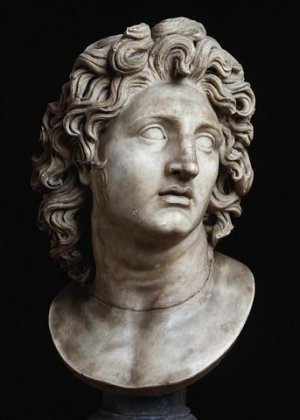
ALEXANDER THE GREAT

Born 356 B.C. - Died 323 B.C.


Alexander the Great
 

Alexander the Great was the son of a Macedonian general named Philip. His mother was Olympias. She told Alexander he was the son of a Greek god, and he seemed to think of himself as divine.

He was a pupil of Aristotle , one of the foremost philosophers* of his time. He studied literature and learned to play the lyre* . He was fearless and strong as a young man.

When he was 12 years old he saw a fine horse he wanted. No one had been able to ride the horse. He offered a wager to his father. If Alexander was able to ride the horse, his father would get it for him. If he failed, he would pay for the horse himself. He determined the horse was terrified of his shadow and that's why he wouldn't let anyone near. He turned the horse so he was facing the sun. In this way he could not see his shadow. He got on the horse and was able to ride him.

His father bought the horse and Alexander named him Bucephalus (bue SEF uh lus). His father said to him, "You must find a kingdom worthy of you, my son. Macedon is too small for you."

He later built a city and named it after his horse, the city of Bucephala.

Alexander became one of the greatest generals in history. When he conquered the Persians he honored their soldiers and commander who had died in battle. When he had won a battle, he combined the remaining soldiers of the enemy with his army to form a greater army. He usually did not allow his soldiers to mistreat the conquered people.

He suffered along with his soldiers when they were at war. If they didn't have water or food, he would not accept food or drink either. When the soldiers were walking, he walked also and refused to ride or be carried. He set an example for his troops.

Once he was trying to capture a city which was on an island in the Mediterranean Sea. It was near the land, so he decided to build a bridge to it. His soldiers put down trees, reeds, and rocks and they began to build a peninsula* out to the island. The people of Tyre did everything they could to stop the soldiers, but in seven months Alexander's troops had built a bridge to the island and conquered the city.


Alexander's Empire

During his life he conquered the then-known world. He controlled Greece, captured Persia and Egypt and built a city in Egypt. He named it for himself, the city of Alexandria. He was the king of Macedonia and a pharoah in Egypt.

He was only 33 years old when he died. Some say he was poisoned. It is just as likely that this great general was defeated by a mosquito because others believe he died of malaria* .


Map of the Empire of Alexander the Great

Ancient Europe - Alexander the Great
by Dr. Ellis Knox.

Alexander the Great
article by Tom Syvertsen

Alexander the Great
history lesson plan from Discovery.com

Alexander Changes the World
by Frank Smitha

Alexander the Great
by Plutarch

Alexander the Great Timeline

Alexander the Great
at Buzzle.com

The Story of Alexander the Great
online book told by Robert Steele

The Story of Alexander the Great
choose the media you want for viewing

Alexander the Great
web biographies


437076: Alexander The Great Alexander The Great
By Peggy Pancella / Heinemann Raintree School

Learn about Alexander the Great; where and when he lived, and why he is famous. Read about his family, childhood, friends, rivals, and enemies. Explore his achievements and discover how we know about them. Boxes throughout the book give interesting insights into daily life - for those in power and for ordinary people as well. The boxes focus on clothes, food, buildings, toys, technology, and religion.Recommended for ages 8 to 12.

22792: Ancient Greece, Thematic Unit Ancient Greece, Thematic Unit
By Teacher Created Resources

Thematic Units from Teacher Created Materials are literature based, cross-curricular, and ready to use. They provide activities, many of them hands-on, for all areas of the curriculum, including math, science, language arts, social studies, physical education, art, and music. Each book offers two or more literature-based units and lesson plans plus cross-curricular activities and worksheets, a culminating activity, management ideas, and a bibliography. Complete and comprehensive, these reproducible units are designed with student interest and teacher usability in mind. The planning is complete. The book used in "Ancient Greece" (that will need to be purchased or borrowed) is: "Ancient Greece" by Anne Pearson There are also several anthologies which contain the myths studied in this unit.

44320X: Greek Heroes: Imitation In Writing Greek Heroes: Imitation In Writing
By Matt Whitling / Logos School

Quintillian would be proud to see your students learning the structure and style of good writing through imitation while they study Greek mythology. This Greek Heroes text is the fourth book in a growing series of Imitation in Writing materials designed to teach aspiring writers the art and discipline of crafting delightful prose and poetry. The text includes a short background of imitation as a means of teaching writing, instructions, grading guidelines, twenty-five myths about Greek Heroes formatted for imitation, and a glossary of Greek gods and terms. Fourth grade and up.


Alexander the Great Word Search


Alexander the Great Crossword Puzzle


Alexander the Great - Word Scramble


Online Crossword Puzzle


Online Word Search


Alexander the Great Study Sheet


Worksheet


Work a Jigsaw Puzzle


From Word Central's Student Dictionary
by Merriam - Webster

(Pronunciation note: the schwa sound is shown by &)

philosopher
Pronunciation: f& 'los & f&r
Function: noun
a person who studies philosophy

philosophy
Pronunciation: 'f& 'los & fee
Function: noun
1 : the study of the basic ideas about knowledge, truth, right and wrong, God, and the nature and meaning of life
2 : the philosophical teachings or principles of a person or group today....

peninsula
Pronunciation: p& 'nin ch& l&
Function: noun
: a piece of land nearly surrounded by water or sticking out into the water
[from Latin paeninsula "peninsula", from paene- "almost" and insula "island" -
See Landforms from Enchanted Learning

malaria
Pronunciation: 'm& 'ler E &
Function: noun
: a disease caused by protozoan parasites in the red blood cells, passed from one individual to another by the bite of mosquitoes, and marked by periodic attacks of chills and fever

lyre
Pronunciation: 'lie (&) r
Function: noun
a small harp held in the hands for playing


Biographies in this Series

Presidents of the
United States
George Washington
1st U.S. President

John Adams
2nd U.S. President


Thomas Jefferson
3rd U.S.President


James Monroe
5th U.S. President


Andrew Jackson
7th U.S. President

Abraham Lincoln
16th U.S.President

Franklin D. Roosevelt
32nd U.S. President

John F. Kennedy
35th U.S. President


James Madison
4th U.S. President

Theodore Roosevelt
26th U.S. President

American Patriots Benjamin Franklin
patriot and statesman

Francis Scott Key
Star Spangled Banner

Deborah Sampson
woman soldier
in the Revolutionary War

World Leaders Constantine
Roman Emperor

Alexander the Great
conqueror
Winston Churchill
British Prime Minister

Inventors Alexander Graham Bell
telephone

Johann Gutenberg
printing press

Cyrus McCormick
mechanical reaper

The Wright Brothers
first airplane

Henry Ford
Automaker

Thomas A. Edison
electric light bulb

Sequoyah
Cherokee alphabet

Nikola Tesla
700 patents

.
Explorers Christopher Columbus
explorer

Meriwether Lewis
explorer

Robert Peary
Arctic explorer

John Muir
Naturalist

Matthew Henson
Arctic Explorer

Sir Edmund Hillary
Mr.Everest

Kit Carson
Indian agent

"Johnny Appleseed"
orchardist

.
Women who made
a difference
Clara Barton
founder of the Red Cross

Helen Keller
overcame blindness & deafness

Florence Nightingale
founder of
nursing profession

Joan of Arc
religious and military leader

Amelia Earhart
Aviator

Annie Oakley
sharpshooter

Susan B. Anthony
Suffragette

Elizabeth Keckly
Seamstress

Harriet Tubman
deliverer of slaves

Anne Frank
Diarist

Eleanor Roosevelt
Humanitarian

.
Scientists George Washington Carver
botanist and educator

Sir Isaac Newton
explained gravity and
properties of light

Marie Curie
scientist, physicist

Louis Pasteur
Biologist

Albert Einstein
physicist, genius

Galileo
Astronomer, physicist

Educators Noah Webster
writer of dictionary

Booker T. Washington
leader and educator

Aristotle
Greek philosopher

Physicians Hippocrates
father of medicine

Walter Reed
discovered cause of yellow fever

Albert Schweitzer
humanitarian

Religious Leaders Increase Mather
Salem witch trials

.
Athletes Lou Gehrig
baseball player

Wilma Rudolph
Olympic gold medal winner

Tiger Woods
golfer

Civil Rights
Leaders
Martin Luther King
civil rights leader

Rosa Parks
bus desegregation

Sojourner Truth
Former slave

Frederick Douglass
Abolitionist

Mary Ann Shadd Cary
Civil rights leader

James Forten
Inventor, abolitionist

Composers Beethoven
composer

Artists John James Audubon
artist and naturalist

Gutzon Borglum
sculptor, Mount Rushmore

Ansel Adams
photographer


Home


Back to Famous Leaders